With the acceleration of globalization, an increasing number of high-net-worth families are implementing cross-border asset allocation strategies. As global hubs for core assets, China and the United States have become preferred destinations for wealth management by affluent individuals. However, cross-border wealth succession is never merely a simple "asset transfer," but rather a complex systemic endeavor involving legal frameworks, tax regulations, and identity verification rules in both countries. Variations in identity authentication processes, asset categories, and inheritance methodologies directly impact the cost, efficiency, and security of wealth transfer.
For high-net-worth families in China and the United States, the most critical concerns often revolve around: What are the differences between inheritance tax and succession tax? How are tax costs for asset transfers calculated under different legal statuses? What are the key procedural steps in cross-border succession practices?
Today, we will comprehensively analyze the key aspects of cross-border wealth succession for high-net-worth families (HNWFs) between China and the United States by integrating legal frameworks and tax regulations from both countries. This analysis aims to clarify the underlying logic, mitigate risks, and provide actionable reference strategies for HNWFs.
1. Core Concepts: Estate Tax vs Inheritance Tax
Many high-net-worth families often confuse the concepts of inheritance tax and succession tax during cross-border wealth transfer. Although both are related to wealth succession, they differ significantly in terms of taxation entities, calculation logic, and applicable rules, and directly determine the tax and fee costs involved in the transfer. Therefore, a clear distinction must be made first.
(1) Estate Tax: A tax levied on the "estate of the deceased," with taxation preceding distribution.
The essence of inheritance tax lies in "taxing the total estate value after the decedents death." In laymans terms, it means "paying taxes before distributing the estate." Its core characteristics are as follows:
l Taxpayer subject: The taxpayer is the executor of the testators will or the estate administrator, rather than the heir. In simple terms, this means "the estate is taxed first, and the remaining portion is then distributed to the children."
l Tax base: The total global estate of the deceased serves as the tax calculation basis (if the deceased is a U.S. tax resident, global assets must be accounted for; if not, only U.S. domestic assets are considered).
l Scope of application: Estate taxes are uniformly levied at the federal level in the United States; at the state level, only six states impose state estate taxes (Connecticut, Hawaii, Illinois, Massachusetts, New York, and Oregon), while the remaining states do not have state estate taxes.
l Core influencing factors: solely related to the tax status of the decedent, and unrelated to the heirs status (whether they are a U.S. citizen or hold a green card).
(2) Inheritance Tax: Taxes are levied on the "inheritance share of the heir," with distribution preceding taxation.
The essence of inheritance taxation lies in "taxing the share obtained by heirs from the estate," which can be colloquially described as "dividing the estate first, then paying taxes." Its key characteristics are as follows:
l Taxpayer subject: The taxpayer is the actual heir, such as children or relatives who inherit the estate. Whoever inherits the estate shall pay the tax.
l Tax base: The tax calculation is based on the share of the estate obtained by the heir, rather than the total estate value; and the tax rate is typically related to the familial relationship between the heir and the decedent (lower rates apply to direct relatives, while higher rates apply to non-relatives).
l Scope of application: No inheritance tax is levied at the federal level in the United States; at the state level, only six states impose state inheritance taxes (Iowa, Kentucky, Maryland, Nebraska, New Jersey, and Pennsylvania), while the remaining states do not have state inheritance taxes.
l Important reminder: No U.S. state imposes both state estate tax and inheritance tax simultaneously, as these taxes are mutually exclusive. High-net-worth families need not worry about double taxation.
(III) Core Tax Categories in Cross-border Inheritance Between China and the United States
By analyzing the asset allocation patterns of high-net-worth families in China and the United States, the key findings are as follows, which directly impact inheritance costs:
l Within China: Currently there is no inheritance tax or estate tax, only small stamp duty (0.05%) and basic fees such as real estate registration fees are required, resulting in extremely low inheritance costs.
l Within the United States: Only federal estate tax needs to be considered; if assets are located in any of the aforementioned 6 states subject to estate tax, additional state estate tax calculation is required; if assets are located in any of the aforementioned 6 states subject to inheritance tax, additional state inheritance tax calculation is required (the two taxes do not coexist).
l Key risk factors: If the decedent or heir is identified as a "U.S. tax resident," they will be required to file tax returns on global assets, with significant changes to the estate tax exemption threshold and taxable scope, directly impacting inheritance costs.
II. Core Rules: Tax-Free Threshold and Tax Rates for U.S. Estate Tax
For international high-net-worth families in China and the United States, U.S. estate tax constitutes the primary tax cost source in cross-border inheritance. The tax exemption threshold and rate directly determine the tax burden of inheritance, with the applicability of the exemption threshold fundamentally contingent upon the decedents U.S. tax resident status (independent of the heirs status).
(1) Core Criteria for Determining U.S. Tax Resident Status
Whether an estate beneficiary qualifies as a U.S. tax resident directly determines the estate tax exemption threshold and taxable scope—a common confusion among high-net-worth families. Many mistakenly believe that "only U.S. citizens or green card holders qualify for substantial tax exemptions," which is not the case. The U.S. tax resident status is determined by two core criteria (meeting either one suffices), and all individuals recognized as U.S. tax residents—regardless of citizenship—can enjoy equal high federal estate tax exemptions.
l Green Card Test: Holders of a U.S. green card are deemed U.S. tax residents regardless of actual residence status in the United States. They are required to pay federal inheritance tax on global assets and enjoy the high tax exemption thresholds exclusive to U.S. tax residents.
l Substantial Residence Test: Individuals who have resided in the United States for a cumulative total of 183 days within the past three years (calculated as: current years days + previous years days × 1/3 + two years prior to the current years days × 1/6) will be deemed U.S. tax residents, even without a U.S. green card or citizenship. They are entitled to the same substantial tax exemption thresholds as green card holders and U.S. citizens, and are required to pay federal inheritance tax on global assets.
If the deceased does not meet any of the above criteria, they are considered a "non-U.S. tax resident" —this group is the only one eligible for an extremely low tax-free allowance (US$60,000) and is only required to pay federal estate tax on assets within the United States, with assets in China exempt from U.S. estate tax taxation. In summary: The high tax-free allowance for U.S. federal estate tax primarily depends on "whether the individual is a U.S. tax resident," rather than "whether they are a U.S. citizen or green card holder." Non-citizens and non-green card holders who meet the substantive residence test can also enjoy the high tax-free allowance.
(II) Federal Estate Tax Exemption Amounts Under Two Different Taxpayer Statuses
The United States federal estate tax adopts a "progressive tax rate system," with the core benefit being the "lifetime tax exemption threshold" —specifically, the portion of the deceaseds total estate value that does not exceed this threshold is exempt from estate tax, while the excess portion is taxed at the corresponding rate. The tax exemption thresholds vary significantly depending on the individuals status:
1. The decedent was a U.S. tax resident (U.S. citizen/green card holder/meets the substantial residence test)
In 2026, the lifetime federal estate tax exemption for individual U.S. tax residents is $15 million, and couples can enjoy a combined exemption of $30 million, with the taxable scope covering global assets (including assets within China). It should be clarified here: U.S. citizens and green card holders are naturally considered U.S. tax residents. Non-citizens and non-green card holders who meet the substantive residence test are also classified as U.S. tax residents, and all three groups enjoy identical exemption amounts.
In 2026, the lifetime federal estate tax exemption for U.S. tax residents is set at $15 million, with couples eligible for a combined exemption of $30 million, and the tax calculation covers global assets.
For example: If the parents are U.S. tax residents and the total estate of the couple is $25 million (including properties in China, properties in the U.S., and deposits), which does not exceed the $30 million tax-free threshold, the entire estate can be inherited tax-free without paying any federal inheritance tax.
2. The decedent is not a U.S. tax resident (no green card and fails the substantive residence test)
The federal estate tax exemption for non-U.S. tax residents is only $60,000, and is only applicable to assets within the United States (assets within China are exempt from U.S. federal estate tax). The portion exceeding $60,000 is taxed at a progressive rate, with a maximum tax rate of 40%.
For instance, if parents are non-tax residents in the U.S. and own a $1 million property within the country (with no other U.S. assets), the portion exceeding the $60,000 tax-free threshold amounts to $940,000. This would incur federal inheritance tax at a progressive rate, resulting in a substantial tax burden.
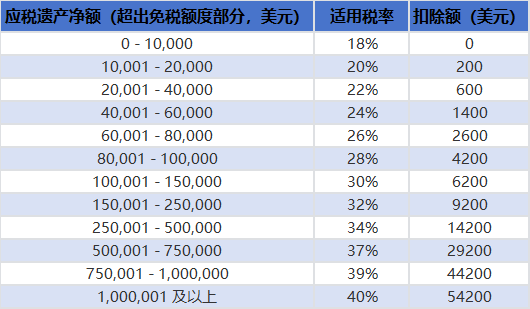
(III) Federal Estate Tax Progressive Rate Schedule in the United States
Regardless of whether the deceased is a U.S. tax resident or non-resident, any amount exceeding the applicable tax exemption threshold shall be taxed at the following progressive rate (only the portion above the threshold is subject to the higher rate, not the full maximum rate):
Important reminder: If the decedent is a U.S. tax resident, both spouses may benefit from the "tax credit carryover" policy. After one spouses death, any unused tax credit can be transferred to the surviving spouse, maximizing tax credit utilization and reducing tax liability.
III. Practical Considerations for Cross-border Inheritance Operations
For high-net-worth families operating across China and the United States, cross-border inheritance primarily involves three critical challenges: "differences in legal frameworks between the two jurisdictions," "notarization and authentication of documents," and "tax filing procedures." Any oversight in these areas may result in inheritance failure, increased tax liabilities, or asset freezes. The cornerstone of cross-border inheritance lies in "document compliance." Regardless of whether the heirs hold U.S. green cards, the following preparations must be completed prior to initiating inheritance proceedings:
l Reviewing the estate details: Conduct a comprehensive review of the decedents global assets, clarifying asset types, locations, and values, with a focus on distinguishing between assets within China (real estate, deposits, company equity, etc.) and assets within the United States (real estate, bank deposits, stocks, retirement accounts, etc.); Entrust professional appraisal agencies to issue asset valuation reports (assets within the United States must comply with local institutional requirements, such as California real estate requiring a "Property Summary").
l Confirming the validity of a will: If the testator leaves a will, it is necessary to verify whether the form of the will complies with the legal requirements of both China and the United States. A China will must conform to the provisions of the Civil Code of the Peoples Republic of China (including handwritten, dictated, or notarized forms), while a U.S. will must comply with local state laws (for example, in California, handwritten wills must be personally written, signed, and dated without witnesses, though the court may require handwriting authentication). In the absence of a will, the estate is distributed according to the statutory inheritance order of both countries (China: spouse → children → parents; U.S.: the statutory order varies slightly by state, with California prioritizing spouse and children).
l Verify identity information: confirm whether the heir (child) holds a U.S. green card (if applicable, provide a copy of the green card; if not, provide a copy of the China passport). This is the core basis for subsequent document preparation and tax declaration.
l Prepare basic documents: Prepare all original documents and copies in advance (all requiring subsequent notarization and authentication), including: death certificate of the decedent, birth certificates of children, proof of kinship, identity documents of the decedent and heirs (passports, green cards, etc.), and asset proofs (property deeds, bank deposit certificates, equity certificates, etc.).
IV. Comprehensive Recommendations for Cross-border Inheritance of High-net-worth Families between China and the United States
By integrating legal frameworks, tax regulations of both China and the United States, and the core needs of high-net-worth families, we have compiled the following four actionable recommendations to help them mitigate risks and optimize succession planning:
Plan identity and asset allocation in advance to mitigate tax risks
Identity determination serves as the fundamental prerequisite for cross-border inheritance. The deceaseds status as a U.S. tax resident directly determines the estate tax exemption threshold and taxable scope. High-net-worth families are advised to proactively plan the identities of both the deceased and heirs to avoid excessive tax liabilities resulting from improper identity identification. Concurrently, strategic asset allocation between China and the U.S. should be implemented, with clear categorization of asset types and locations, to develop targeted tax planning strategies.
Make full use of tax exemption quotas to legally reduce tax burdens
If the deceased is a U.S. tax resident, it is essential to fully utilize the federal estate tax exemption limit of $15 million per person (or $30 million for couples) by employing cross-border family trusts and lifetime gifts to reduce taxable estate value. For non-U.S. tax residents, special attention should be paid to the $60,000 tax exemption limit for assets held within the United States, utilizing tools such as trusts and insurance to optimize tax liabilities for excess assets.
Draft bilingual wills in advance and complete cross-border notarization certification
A will serves as the core legal document for cross-border inheritance. It is recommended that high-net-worth families draft bilingual notarized wills in both Chinese and English in advance, clearly specifying key information such as inheritance distribution plans, heir identities, and estate administrators. Concurrently, cross-border consular certification should be completed to ensure the wills validity in both China and the United States. This approach helps avoid inheritance disputes or will invalidation due to non-compliance with formal requirements.
Engage a professional team to manage compliance risks throughout the process
Cross-border inheritance involves multiple fields including legal, tax, and notarization regulations between China and the United States, with complex procedures and intricate rules. It is advisable for high-net-worth families to engage professional teams (such as California-based attorneys, tax accountants, and cross-border trust consultants) in advance to assist with asset structuring, inheritance planning, notarization certification, and tax filing. This approach helps avoid delays, increased tax burdens, or asset loss caused by unfamiliarity with regulatory requirements.
epilogue
Cross-border wealth succession among high-net-worth families between China and the United States is never merely a simple asset transfer, but rather a systematic endeavor involving legal, tax, identity, and asset preservation considerations. The core focus lies not in acquiring more assets, but in how to safely, efficiently, and cost-effectively transfer assets to the next generation.
For high-net-worth families, the key to cross-border wealth succession lies in "early planning" —clarifying identity rules, assessing tax costs, optimizing inheritance tools, and streamlining operational procedures—to achieve smooth wealth transfer while mitigating risks.
Note:
1、Official text of the U.S. Congress:
https://www.govinfo.gov/content/pkg/PLAW-119publ21/pdf/PLAW-119publ21.pdf
2、Official statement from the U.S. Internal Revenue Service on inheritance tax matters:
https://www.irs.gov/businesses/small-businesses-self-employed/frequently-asked-questions-on-estate-taxes
3、IRS Form 709-NA Filing Guidelines:
https://www.irs.gov/ht/businesses/small-businesses-self-employed/whats-new-estate-and-gift-tax
4. IRS Substantial Residence Test Rule: https://apps.irs.gov/app/vita/content/0602/0602_01_015.jsp
5. Consular Authentication Measures on the Chinese Government Website: https://www.gov.cn/zhengce/2015-11/19/content_5713659.htm